Knowing how to dilute Castile soap helps you measure consistently, avoid unnecessary product use and prepare the right amount for the task. A ratio that looks simple on a label can become confusing when you need to fill a 250 ml dispenser or a 500 ml bottle.
This guide explains soap-to-water ratios, provides a practical measurement chart and covers common dilution mistakes. Choose the dilution recommended for your particular product and application first, then use the chart to calculate the quantities.
Why Castile Soap Dilution Depends on the Formula
Liquid Castile soap is made from saponified plant oils, but products sold under this name can differ in concentration, oil blend and intended use. Our ingredients guide introduces the oils used across our range.
Two bottles with the same volume do not necessarily contain the same concentration of soap. A dilution recommended for one formula should therefore not automatically be applied to another.
The application matters too. Preparing soap for a compatible foaming dispenser is different from adding a measured dose to a bucket of cleaning water.
How to Read a Castile Soap Dilution Ratio
Throughout this guide, ratios mean soap, measured by volume.
For example, 1:4 means one part soap plus four parts water. Together, they make approximately five parts of mixture.
If one part is 100 ml:
- Soap: 100 ml
- Water: 400 ml
- Prepared mixture: approximately 500 ml
A 1:10 soap-to-water ratio contains eleven total parts. However, some suppliers use “1 in 10” to mean one part product within ten total parts. Always check the wording rather than assuming these instructions are interchangeable.
Use the same measurement unit for both ingredients. Millilitres are convenient for small batches and avoid differences between household cup and spoon sizes.
Castile Soap Dilution Chart: 250 ml, 500 ml and 1 L
The table below is a measurement calculator, not a set of product-specific usage recommendations. Use a row only when that ratio is appropriate for the formula and task.
Each cell lists soap + water, in millilitres.
| Soap ratio | Approx. 250 ml mixture | Approx. 500 ml mixture | Approx. 1 L mixture |
|---|---|---|---|
| 1:3 | 62.5 + 187.5 ml | 125 + 375 ml | 250 + 750 ml |
| 1:4 | 50 + 200 ml | 100 + 400 ml | 200 + 800 ml |
| 1:9 | 25 + 225 ml | 50 + 450 ml | 100 + 900 ml |
| 1:10 | 22.7 + 227.3 ml | 45.5 + 454.5 ml | 90.9 + 909.1 ml |
| 1:19 | 12.5 + 237.5 ml | 25 + 475 ml | 50 + 950 ml |
Quantities are measured by volume and rounded where necessary. Leave sufficient space in the container for its pump or closure.
To calculate another batch size:
Soap volume = target mixture volume ÷ total number of parts
Water volume = soap volume × number of water parts
For a 500 ml mixture at 1:4, divide 500 by five. This gives 100 ml of soap and 400 ml of water.
A 1:9 mixture contains 10% of the original bottled product by volume. That figure describes the amount of product added; the active soap content depends on the original formula.
Choosing a Dilution for Different Uses
Start with the product label, then check any instructions for the dispenser, surface or equipment involved.
| Application | What to check before preparing the soap |
|---|---|
| Foaming hand-soap dispenser | Whether the formula is suitable, its recommended dilution and the pump’s operating requirements |
| Conventional liquid-soap pump | Whether the product should be dispensed as supplied; a foaming-pump recipe may be unsuitable |
| Handwashing dishes | The product’s hand-dishwashing directions, dosage and rinsing requirements |
| Household surfaces | Surface compatibility, recommended dose and whether rinsing is required |
| Floor cleaning | Flooring manufacturer’s instructions, water exposure limits and product suitability |
| Personal washing | Labelled use, application method and rinsing instructions |
For context, Dr. Bronner’s dilution guide gives 1:3 for a foaming dispenser and 1:10 for a hand-dishwashing mixture using its own liquid soap. These illustrate how ratios vary by application; they are not validated instructions for every Castile soap.
For Anatolian Castile Soap, contact our team with the exact product and intended use to confirm the appropriate directions.
How to Measure and Mix Castile Soap
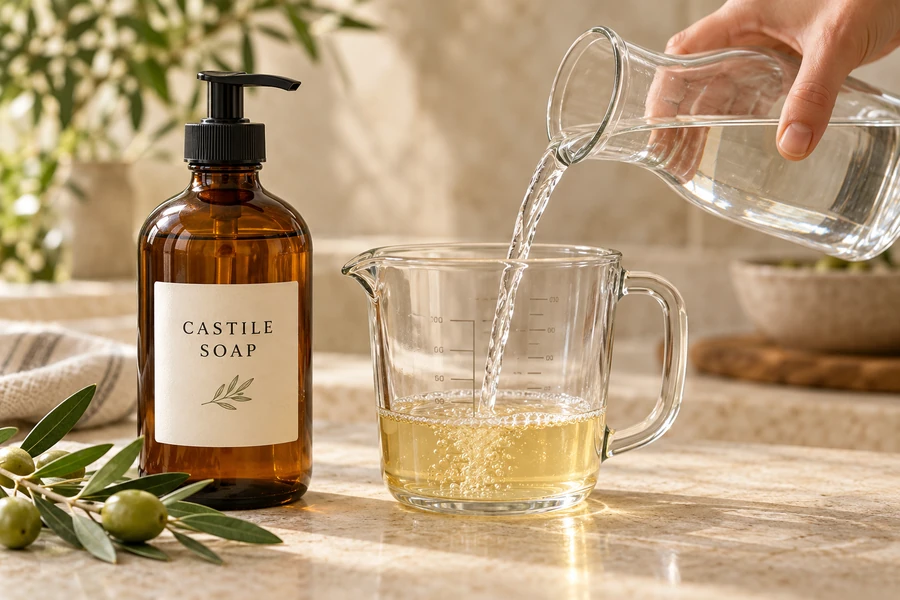
Once you have confirmed the ratio, prepare the mixture carefully:
- Choose a suitable container. Check its usable capacity and compatibility with the product.
- Prepare clean equipment. Follow the container and dispenser manufacturer’s cleaning instructions.
- Measure the water. Use the water quality specified for the application.
- Measure the soap separately. A graduated measuring vessel is more consistent than estimating capfuls.
- Combine gently. Adding the measured water first can help limit foaming during preparation.
- Label the container. Record the product, dilution ratio and preparation date, together with the applicable use instructions.
Avoid vigorous shaking when gentle mixing is sufficient. A bottle full of foam makes it harder to judge the liquid level and can complicate dispensing.
How Hard Water Affects Diluted Castile Soap
Water quality can influence the result even when the measurements are correct. Hard water contains dissolved minerals, particularly calcium and magnesium. The US Geological Survey explains that soap can react with calcium to form soap scum.
If a mixture becomes cloudy or leaves a film, review the water quality, dosage and rinsing process before increasing the amount of soap. Adding more of the same hard water does not remove its hardness minerals.
Low-mineral water may help with mineral-related issues during preparation, but it does not establish the microbial safety or shelf life of a stored mixture.
Our guide to the difference between Castile soap and detergent explains the distinction between these cleaning systems.
Common Castile Soap Dilution Mistakes
Confusing Added Water with Final Volume
If the directions say “add 50 ml soap to 500 ml water,” the result is approximately 550 ml of mixture. Preparing a total of 500 ml with 50 ml soap requires approximately 450 ml water.
Read whether the instruction specifies water added or final mixture volume.
Assuming More Soap Always Improves Cleaning
Increasing the dose also increases the amount of product that must be rinsed away. Follow the recommended dosage and consider the type of soil, surface and water conditions when investigating poor results.
Mixing Soap Directly with Vinegar or Lemon Juice
Acids can react with true soap, producing fatty acids and a curdled or oily-looking mixture. Lisa Bronner’s explanation of soap and vinegar describes why combining the two can undermine cleaning performance.
Use the formulation as directed rather than adding household acids to adjust it.
Treating Hand-Dishwashing Soap as Dishwasher Detergent
Handwashing dishes and cleaning them in an automatic dishwasher have different requirements. Do not assume that dilution makes a foaming soap suitable for a dishwasher. Follow the appliance instructions and use a product intended for that application.
Adding Essential Oils Without Reviewing the Formula
An unscented Castile soap provides an option without added fragrance. Adding essential oils changes the product and can affect compatibility and suitability for its intended use.
For a commercial scented product, discuss custom formulation rather than relying on an improvised recipe.
How Long Can You Store Diluted Castile Soap?
There is no universal storage period for every diluted Castile soap mixture. Formula, dilution, water quality, packaging and handling all matter.
The FDA’s microbiological safety guidance explains that added water can introduce microorganisms and dilute preservatives. The shelf life of the original bottle should not be transferred automatically to a homemade mixture.
Prepare only the quantity supported by the product’s directions, keep containers clean and follow the stated storage conditions. If no storage guidance is available for a dilution, ask the supplier before preparing it for prolonged storage.
A normal appearance or smell alone cannot establish that a mixture is microbiologically safe.
Bulk Refilling and Commercial Dilution
Refilling transfers the supplied product into another suitable container. Dilution changes its composition by adding water.
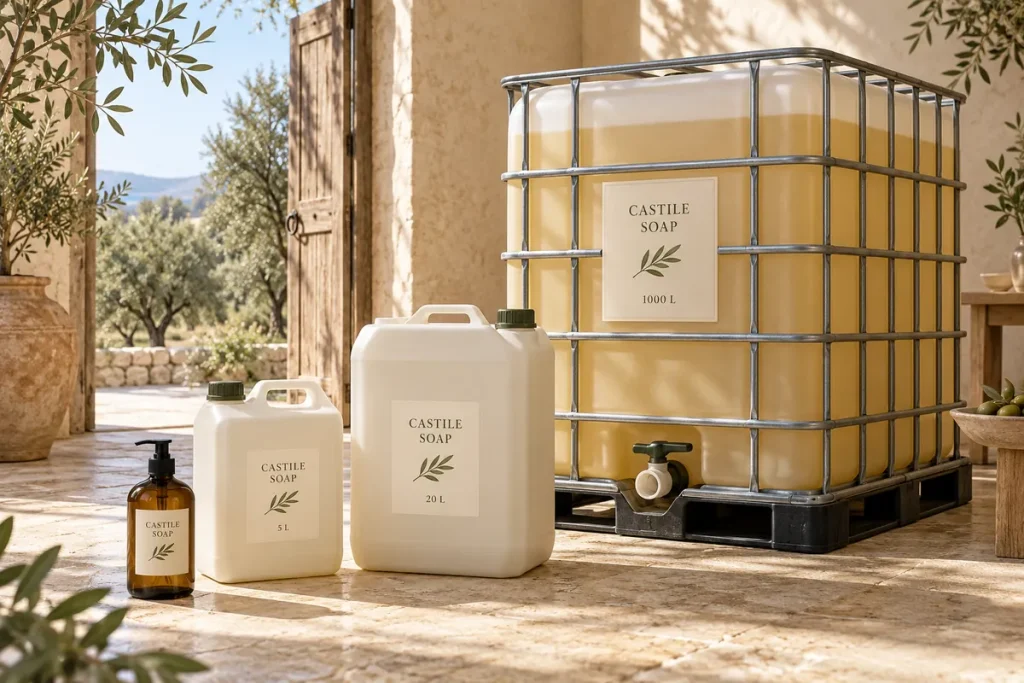
Anatolian Castile Soap can supply liquid soap in 5-litre containers, 20-litre containers and 1,000-litre IBC tanks. These pack sizes describe the supply format; they do not determine a dilution ratio.
Businesses using bulk liquid Castile soap for retail filling should confirm the formula, dispensing system and packaging requirements. A product diluted for resale needs assessment of its final composition, stability, preservation and labelling.
Explore our private-label Castile soap services when planning a finished product for your own brand.
Frequently Asked Questions
What does a 1:4 Castile soap ratio mean?
In this guide, it means one part soap plus four parts water. For example, 100 ml soap mixed with 400 ml water gives approximately 500 ml of mixture.
Is a 1:10 dilution the same as a 10% product mixture?
A 1:10 soap-to-water ratio contains one part soap in eleven total parts, or approximately 9.1% original product by volume. A 10% product mixture uses one part soap plus nine parts water.
Can I use the same dilution for hands, dishes and floors?
Confirm the directions for each application. Formula suitability, rinsing, dispensing equipment and surface compatibility can differ.
Does buying a larger container mean I should add more water?
No. A 5 L, 20 L or 1,000 L container may contain the same supplied formula. Check the product specification and usage directions rather than judging concentration from pack size.
Find the Right Castile Soap for Your Application
Accurate measurements start with a suitable product and clear directions. Use the dilution chart to prepare consistent quantities once the appropriate ratio has been confirmed.
Request a Castile soap sample to evaluate the formula for your application, or speak with our team about retail, refill and bulk supply requirements.
Choosing Castile Soap for Your Daily Routine
Choosing the right formula is the first step towards using diluted soap effectively. Explore our liquid Castile soap range and learn about the plant oils behind our formulations in our ingredients guide. Understanding the product’s composition and intended use helps you select suitable applications and follow the correct dilution instructions.
For those who prefer a formula without added fragrance, our unscented liquid Castile soap offers an option for their routine. You can also explore lavender liquid Castile soap and peppermint liquid Castile soap. Whichever formula you choose, follow its specific directions and confirm the recommended dilution for your intended application.
If you are comparing cleaning products, our guide to the difference between Castile soap and detergent provides useful background. For additional product questions, visit our frequently asked questions or browse the Castile soap blog for more information about our soaps and their uses.
For refill shops, distributors and businesses, our bulk liquid Castile soap is available in 5-litre containers, 20-litre containers and 1,000-litre IBC tanks. We also offer custom and private-label Castile soap solutions for brands developing their own range. Request a sample to evaluate the product, or contact our team to discuss your formula, packaging and usage requirements.